

CRC Assembly Machine 440 Combo: Two-Piece Child-Resistant Cap Assembly & Liner Insertion
Inner and outer cap combining, liner insertion and missing-wad inspection in a single pass, with a straight answer on what’s automatic and what isn’t.
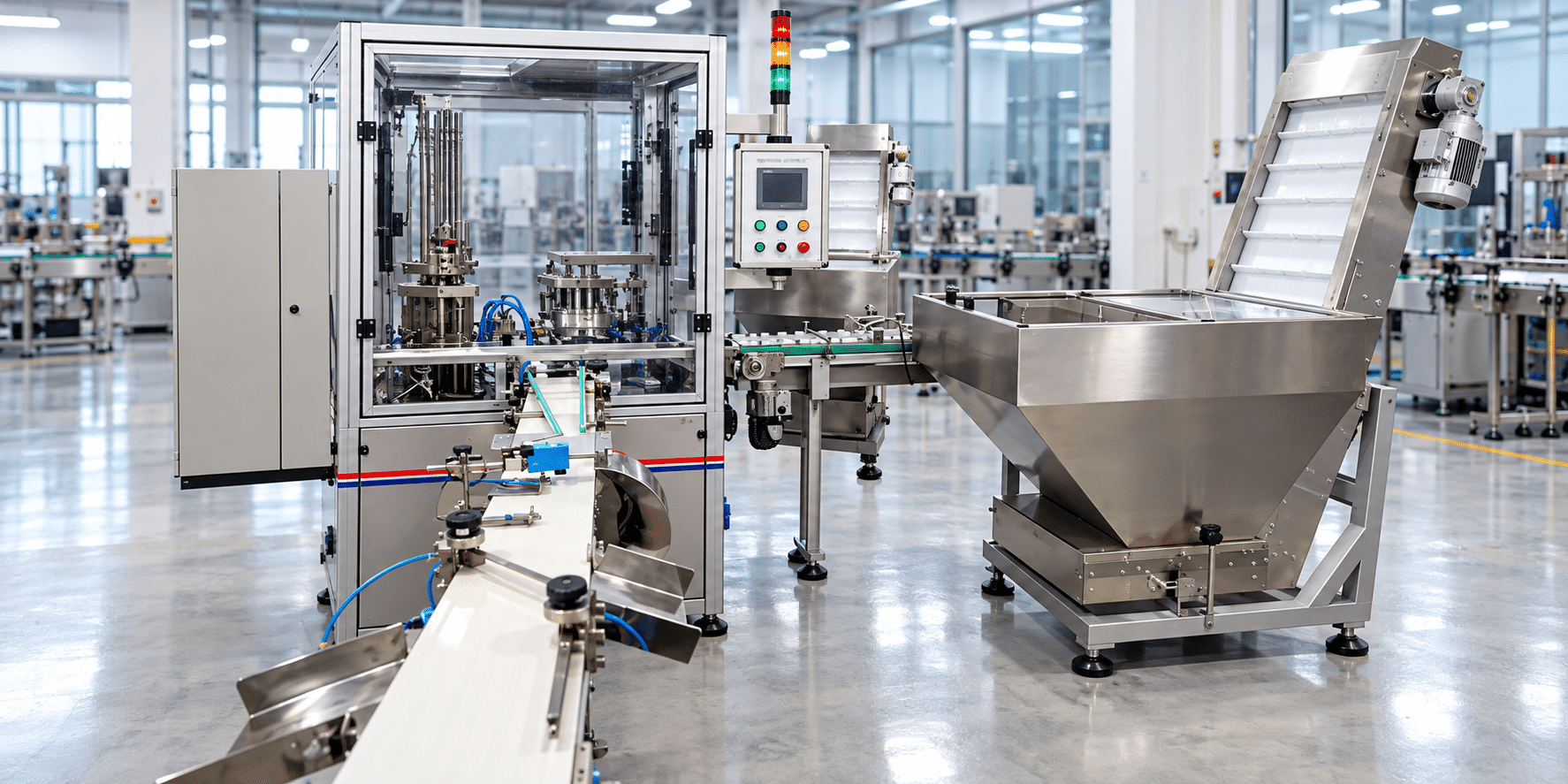
The CRC 440 Combo assembles two-piece child-resistant closures. Inner and outer caps are combined on a two-deck star wheel and pressed together at a plunger assembly station. Every finished cap is then inspected, and any cap with a missing wad is automatically rejected.
Inner & Outer Cap Assembly
Liner Insertion
Automatic Missing-Wad Rejection
Cap & Closure Automation
2
Hoppers (Inner & Outer)
2-Deck
Star Wheel
1
Plunger Assembly Station
Built-In
Inspection & Reject
What the CRC 440 Combo Does
A child-resistant closure isn’t one part. It’s an inner cap and an outer cap, molded separately, that have to be combined and lined with a wad before the finished closure is ready for capping. Miss the wad, and the closure fails the one job it exists to do.
The CRC 440 Combo does that combining and checking in a single pass, so a missing wad gets caught on the machine, not downstream on your line.
How the CRC 440 Combo Works
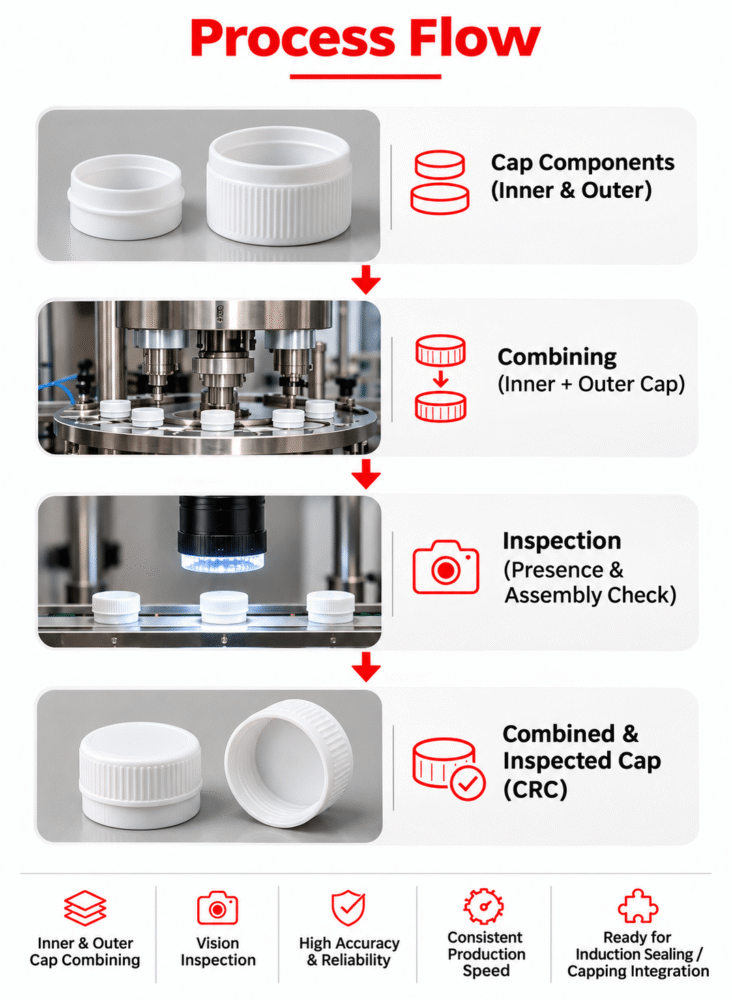
Inner and outer caps are loaded into separate hoppers, then fed onto a two-deck star wheel: the inner cap by chute to the upper deck, the outer cap by conveyor to the lower deck. As the star wheels index, the inner cap drops onto the outer cap and a plunger presses them together. The assembled cap is then inspected, and any cap missing a wad is rejected.
1
Manual Cap Loading
Inner and outer caps are dumped manually into their own hoppers to start the run.
2
Cap Feed to the Star Wheels
The inner cap feeds through a chute to the upper deck star wheel; the outer cap feeds by conveyor to the lower deck star wheel, directly below.
3
Star Wheel Indexing & Plunger Assembly
As the star wheels index, the inner cap drops onto the outer cap. Under the plunger assembly, the two are pressed and assembled.
4
Outgoing Inspection & Rejection
Assembled caps travel out on the outgoing conveyor for inspection. Caps with a missing wad are rejected; OK caps are collected in the collecting bin.
Automatic vs. Manual: What's Actually Automated
“Fully automatic” gets used loosely in this category. Here’s exactly where the CRC 440 Combo draws the line.
What's Manual
Loading. Inner and outer caps are dumped into their respective hoppers by hand at the start of each run. That’s the one manual step in the process.
What's Automatic
Everything from there on: feeding to the star wheels, indexing, plunger assembly, outgoing inspection and rejection all run without operator intervention.
CRC 240 Combo vs. CRC 440 Combo: Which Model Fits Your Line?
Both models run the same confirmed mechanism. Here’s how to think about the difference.
Same Mechanism, Different Model Number
The CRC 240 Combo and CRC 440 Combo share the same assembly sequence: manually loaded hoppers, a two-deck star wheel, a plunger assembly station, and outgoing inspection with automatic rejection. What the model number itself changes is confirmed with Sigma CapSeal applications engineering rather than assumed here.
How to Choose the Right Model
Since the underlying mechanism is identical, the right model for your line comes down to your cap specification and target output. Share your inner cap, outer cap and liner components with Sigma CapSeal applications engineering, and they’ll confirm which model, 240 or 440, fits your line.
CRC Cap Assembly vs. Standard Cap Assembly
“CRC” and “cap assembly machine” get used interchangeably online. Here’s what actually separates them.
What "CRC" Means
CRC stands for child-resistant closure: a cap built specifically to be difficult for young children to open, typically found on pharmaceutical, household chemical and other regulated or safety-sensitive products.
CRC Assembly vs. Sigma CapSeal's CTC Range
Sigma CapSeal’s CTC range (CTC 100, CTC 200 and CTC 300) also assembles two-piece caps, but with a different mechanism: automatic vibratory bowl feeders and a pressing roller. The CRC 440 Combo uses manually loaded hoppers, a two-deck star wheel and a plunger assembly instead, plus built-in liner insertion and missing-wad inspection that the CTC range doesn’t include. If your closure isn’t child-resistant, the CTC range is likely the better fit.
Key Features and Engineering Advantages
Built around one goal: catch a defective closure on the machine, not on your line.
Dual-Deck Star Wheel Indexing
Inner and outer caps run on two separate decks that index together, so every inner cap arrives over its matching outer cap before the press station.
Liner (Wad) Insertion
Assembly and liner insertion happen on the same machine, in the same pass, with no separate lining step or second machine required.
Automatic Missing-Wad Detection & Rejection
Every assembled cap is inspected on the outgoing conveyor. A missing wad gets rejected automatically, before it reaches your collecting bin.
Combined Assembly-and-Lining Footprint
One machine does the work of a separate assembly station and lining station, with a shared inspection step at the end.
Closure Compatibility
The CRC 440 Combo is built for two-piece child-resistant closures. Confirm exact cap geometry and liner specification with Sigma CapSeal applications engineering for your SKU.
Closure Types
- Child-resistant inner/outer cap closures
- Other two-piece CRC formats (confirm per SKU)
Component Requirements
- Separately supplied inner cap component
- Separately supplied outer cap component
- Liner / wad, sized for the hopper and star-wheel pockets (confirm tooling per cap size)
See the CRC 440 Combo in Action
Watch the assembly and inspection sequence, then download the brochure for full specifications.
Where the CRC 440 Combo Fits in Your Packaging Line
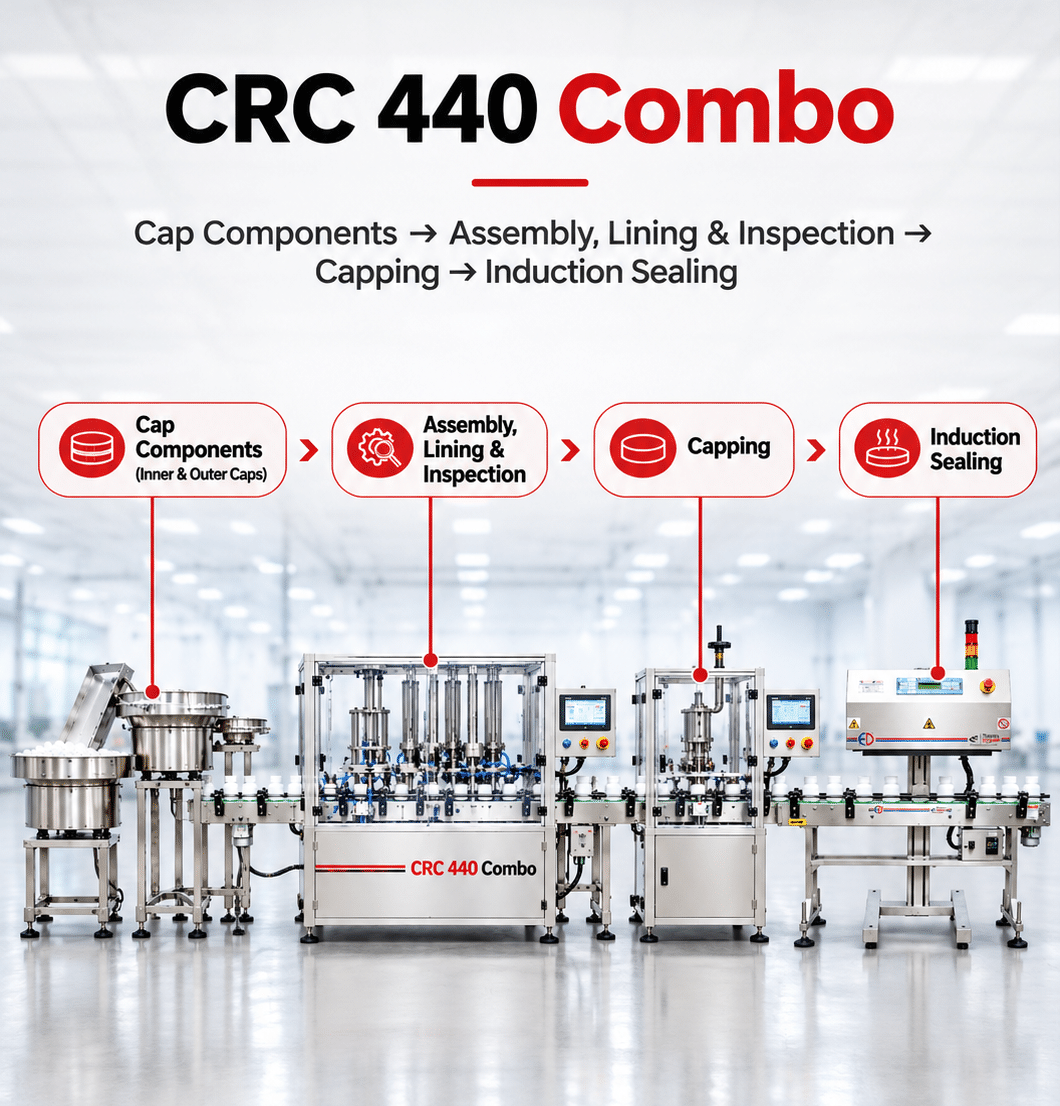
In a typical line, the CRC 440 Combo sits between your cap component supply and your capping station: inner and outer caps go in, one finished, lined and inspected child-resistant closure comes out.
If your finished cap carries a foil induction liner as well, Sigma CapSeal’s induction sealing range (Sigma Flex, Sigma I Neo, Sigma II Neo, Sigma III Touch and Sigma Jet + CFR) bonds that liner to the container after capping. Running assembly and sealing equipment from one manufacturer keeps service, spares and support on a single line.
Installation requirements, including power input and footprint, are confirmed with Sigma CapSeal applications engineering based on your line layout and closure specification.
Where the CRC 440 Combo Is Used
Child-resistant closures exist mainly because a regulation or a safety requirement calls for one, which puts this machine’s use cases closer to pharma than to general cap assembly.
Pharmaceuticals & OTC
Child-resistant closures for prescription and over-the-counter products, assembled and inspected to a consistent standard.
Household & Specialty Chemicals
CRC closures for household and specialty chemical products where child-resistant packaging is required or expected.
Nutraceuticals
Child-resistant closures for supplement and nutraceutical packaging.
Agrochemicals
CRC closures for agrochemical containers, assembled ahead of capping and sealing.
CRC 440 Combo Technical Specifications
Confirmed mechanism details below. Output, sizing and power figures are matched to your closure by applications engineering.
- Parameter
- CRC 440 Combo Specification
Machine Type
CRC (child-resistant closure) cap assembly and liner-inserting combo machine
Cap Loading
Manual: inner and outer caps dumped into separate hoppers
Cap Feed System
Inner cap via entry chute to upper deck star wheel; outer cap via conveyor to lower deck star wheel
Assembly Method
Star wheel indexing with plunger assembly press station
Inspection & Rejection
Automatic inspection for missing wads on the outgoing conveyor, with automatic rejection and collection of OK caps
Output Speed
Contact Sigma CapSeal applications engineering to confirm for your configuration
Cap Size Range
Contact Sigma CapSeal applications engineering to confirm for your configuration
Power Input
Contact Sigma CapSeal applications engineering to confirm for your configuration
Construction
Contact Sigma CapSeal applications engineering to confirm for your configuration
Dimensions / Net Weight
Contact Sigma CapSeal applications engineering to confirm for your configuration
Control Panel
Contact Sigma CapSeal applications engineering to confirm for your configuration
Configuration varies with cap size and closure geometry. Contact Sigma CapSeal applications engineering for a full specification matched to your components.
50+
Years of Experience
85+
Countries Served
Global
Reach & Service
MNC
Client References
Responsive Service
The machine on day one rarely decides repeat business; whether the spare part shows up and the engineer answers does. We back the CRC 440 Combo with the same global service and spare-parts support as the rest of the Sigma CapSeal range.
Why Choose Sigma CapSeal for CRC Assembly
Sigma CapSeal designs, manufactures and supports induction sealing and cap and closure automation that improves product safety, line efficiency and packaging integrity across pharmaceutical, food, personal care, agrochemical and specialty chemical industries.
Frequently Asked Questions: CRC Assembly Machine 440 Combo
What is a CRC cap assembly machine?
A CRC cap assembly machine combines a child-resistant closure’s inner and outer cap components and inserts the liner, before that finished cap is applied to a bottle. A CRC combo machine, like this one, does assembly and liner insertion in one pass.
How does the CRC 440 Combo detect a missing wad?
Assembled caps travel out on the outgoing conveyor, where they’re inspected. Caps with a missing wad are automatically rejected; caps that pass are collected in the collecting bin.
Is the CRC 440 Combo the same as Sigma CapSeal's 440M wad inserting machine?
No. The 440M is a separate machine that inserts precut liners into single caps using a bowl feeder and vacuum pick-and-place system. The CRC 440 Combo assembles two-piece inner and outer caps using manually loaded hoppers, a two-deck star wheel and a plunger assembly. They share a model number, not a mechanism.
What industries use CRC assembly machines?
Primarily pharmaceuticals and OTC products, where child-resistant closures are often required, along with household and specialty chemicals, nutraceuticals and agrochemicals.
Is the CRC 440 Combo fully automatic?
Not entirely. Inner and outer caps are loaded into the hoppers manually. From there, feeding, star wheel indexing, plunger assembly, inspection and rejection all run automatically.
What's the difference between the CRC 240 Combo and the CRC 440 Combo?
Both run the same confirmed mechanism: manually loaded hoppers, a two-deck star wheel, and a plunger assembly, with outgoing inspection and rejection. What specifically separates the two model numbers is confirmed with Sigma CapSeal applications engineering for your line.
What's the difference between CRC assembly and Sigma CapSeal's CTC cap assembly machines?
Both assemble two-piece caps, but the mechanisms differ. The CTC range (CTC 100 / CTC 200 / CTC 300) uses automatic vibratory bowl feeders and a pressing roller. The CRC 440 Combo uses manually loaded hoppers, a two-deck star wheel and a plunger assembly, plus built-in liner insertion and missing-wad inspection.
How do I get exact specifications for my line?
Share your inner cap, outer cap and liner components, your container, and your target output with Sigma CapSeal applications engineering, and they’ll confirm size range, speed and configuration for your line.
Spec a CRC 440 Combo for Your Closure
Send us your inner cap, outer cap and liner components, and Sigma CapSeal applications engineering will confirm fit, tooling and configuration.