

140 L: Star-Wheel Indexed Wad/Liner Inserting & Cap Lining Machine
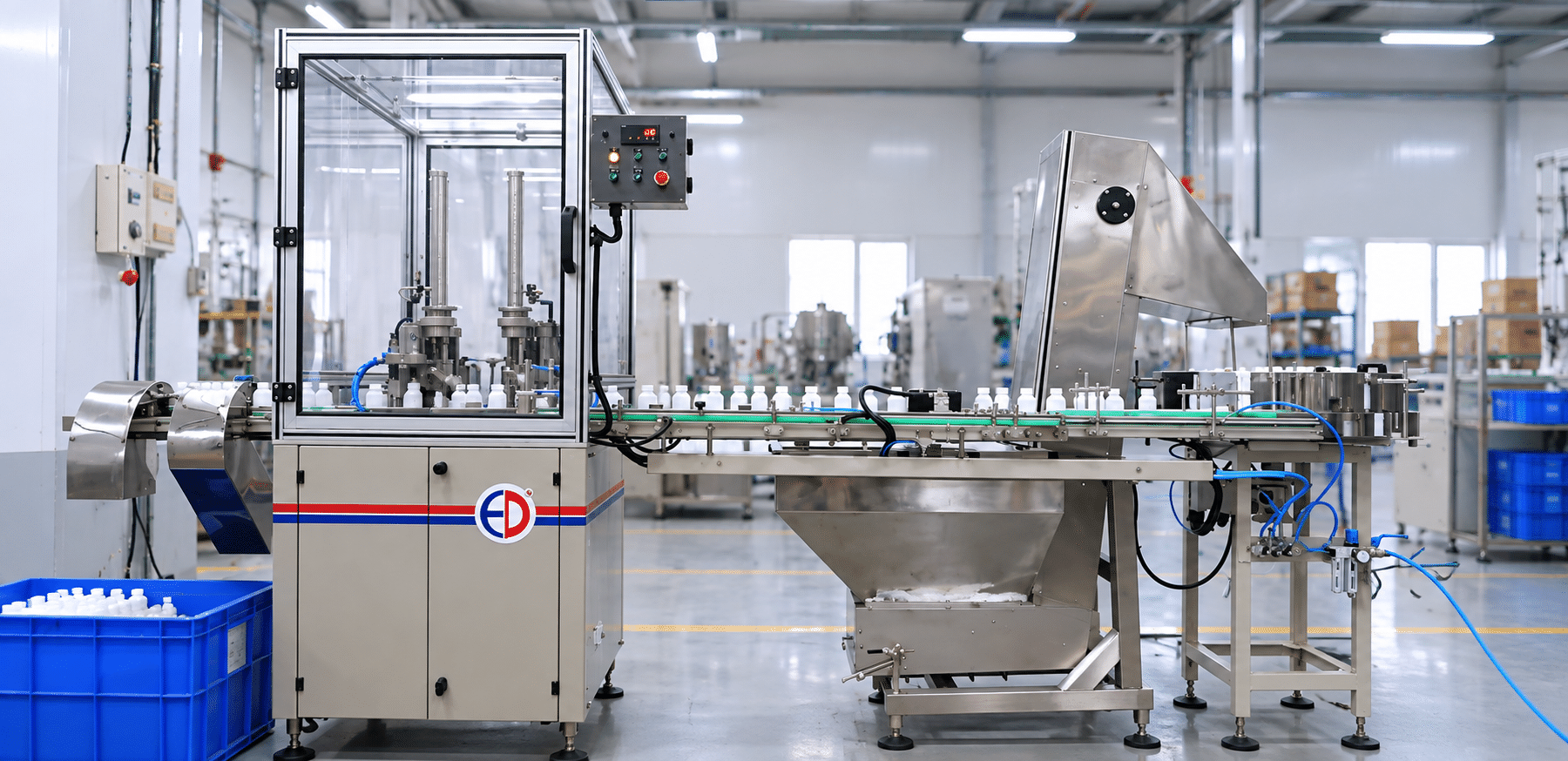
One person used to stand at a bin, dropping wads into caps by hand. The 140 L does it instead. A star wheel indexes every cap into position, and a vacuum cup seats the wad, 40 to 60 times a minute, placed the same way every time.
Built for 20 mm to 120 mm caps on one frame, running induction foil liners, EP or Foam liners, or pulp wads without a head change.
40-60
CPM
Single
Head
20-120 mm
Cap Range
PLC
Controlled
40-60 CPM
Rated Speed
20-120 mm
Cap Diameter Range
Single Head
Vacuum Transfer
415 V
Three Phase, 50/60 Hz
SS Contact
Parts, GMP-Ready
PLC
The Machine That Replaces a Person Standing at a Bin of Wads
Most plants that outgrow hand-lining caps don’t need the fastest machine in the catalog. They need one that gets the wad in straight, every time, without adding a second operator to the line. That’s what the 140 L is built for: a single-head machine that holds 40 to 60 caps a minute for a full shift, not just the first ten minutes.
It sits at the entry point of Sigma CapSeal’s wad/liner inserting range. If your SKU count or line speed outgrows a single head, the 240 L and 440 L run the same indexing and vacuum principle with more heads bolted on.
How the 140 L Actually Lines a Cap
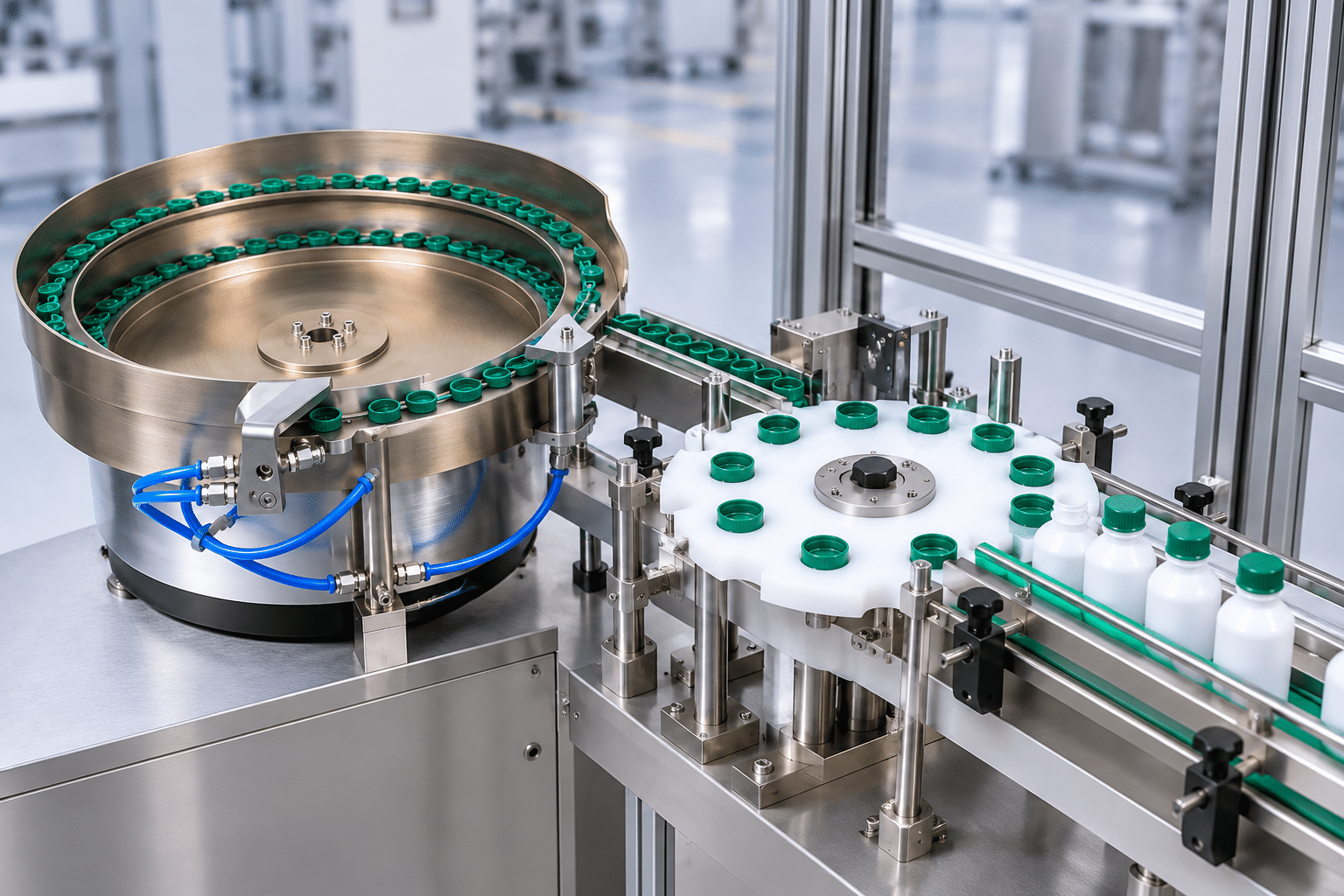
Four things happen between a bin of loose caps and a finished, lined cap dropping off the machine. Here’s the sequence, in the order it happens on the frame.
1
Bowl Feed & Orientation
Caps load into the bowl feeder loose, in any orientation. The bowl sorts and flips them until every cap sits cavity-facing-up, then feeds them onto the conveyor belt one after another.
2
Conveyor to Star Wheel
The belt carries oriented caps to the star wheel, which is the part actually doing the timing work. Each pocket on the wheel picks up one cap and holds it in place.
3
Magazine Wad Stack
Separately, pre-cut wads sit stacked in a gravity magazine, liner-face-down, so the foil or EP surface is presented in exactly the orientation the vacuum head expects.
4
Vacuum Index & Placement
Every time the star wheel indexes forward, a vacuum cup lifts the bottom wad off the magazine stack and seats it into the cap held below. One index, one cap, one wad, 40 to 60 times a minute.
Watch the 140 L in Action
The bowl feeder, star wheel and vacuum head in one continuous cycle, filmed on the shop floor at rated speed.
Want the Full Spec Sheet?
Download the brochure for dimensions, tooling change parts and duty cycle detail beyond what's on this page.
What You're Actually Buying
What matters when this machine has to run a shift without babysitting.
Star Wheel Indexing
Mechanical timing means the cap is always in the same position when the vacuum cup fires. That consistency is what keeps reject rates down at the capping and sealing stage downstream.
One Frame, 20-120 mm
Small pharma caps and large edible-oil caps run on the same base machine. Changing size means swapping star wheel and bowl tooling, not buying a second unit.
Vacuum Transfer, Not Gravity Drop
A vacuum cup actively places the wad rather than letting it fall, so it seats flat and centered even on caps that aren’t perfectly level on the star wheel.
Liner-Agnostic Head
Induction foil liners, EP or Foam liners, and pulp wads all run through the same vacuum head. What matters is the wad’s outer diameter matching the cap, not what’s laminated to it.
Stands Alone or Feeds a Line
Run it as a standalone station feeding lined caps into totes, or position it ahead of a capping machine and an induction sealer so caps arrive pre-lined with no manual step in between.
Stainless Contact Parts
Everything touching the cap or wad is stainless steel on a self-standing frame, built to the same GMP baseline as the rest of the Sigma range.
Cap, Wad and Container Compatibility
The star wheel and vacuum head stay fixed. What changes underneath them is the cap, the wad, and the container it ends up on.
Caps & Closures
- Standard continuous-thread screw caps
- Child-resistant caps (CRC)
- Dome caps
- Flip-top caps
- Snap-on caps
Wads & Liners
- Induction foil liners, one and two-piece
- EP (expanded polyethylene) liners
- Foam liners
- Pulp board wads
- Heat-seal wads matched to cap diameter
Where It's Used
- Pharma and nutraceutical bottles
- Food, dairy and beverage containers
- Edible oil and lubricant caps
- Agrochemical and speciality chemical closures
140 L, 240 L, or 440 L: Pick by Head Count
All three run the same star-wheel indexing and vacuum transfer principle. The only real decision is how many caps a minute your line needs.
- Model
- Heads & Speed
- Best For
240 L
Double head, 80-120 CPM
Mid-volume lines running one or two cap sizes
440 L
Four head, 160-200 CPM
High-volume bottling lines feeding a fast capper
Running small pharma caps at high volume? Step up to the 240 L or 440 L. Running 80-120 mm caps at moderate, single-shift volume? The 140 L is sized for exactly that; don’t pay for heads you won’t use.
Throughput and What It Replaces
40-60 CPM
One Head, One Operator's Job Gone
A single operator hand-lining caps rarely holds this pace for a full shift without drift in placement quality. The 140 L holds it at minute sixty the same as minute one.
Fewer Rejects
Caught Before the Sealer, Not After
A wad seated off-center or upside-down shows up later as a failed induction seal, and by then it’s a rejected bottle, not just a rejected cap. Catching it at the wad/liner-insertion stage instead is the whole point of automating this step.
One Tooling Change
Between Cap Sizes
A plant running two SKUs at, say, 30 mm and 90 mm doesn’t need two machines side by side. It needs one 140 L and two sets of star wheel and bowl feeder tooling.
Standalone Station or In-Line Feed
Plenty of buyers run it by itself, feeding lined caps into totes for a separate capping step. Just as many bolt it straight onto the line, right before the capper and sealer, so caps show up already lined.
- Standalone footprint, no conveyor tie-in required
- In-line positioning ahead of capping and induction sealing equipment
- Changeover parts sized to your cap and wad dimensions at quoting
- PLC control for star wheel timing and vacuum cycle
- Magazine capacity confirmed against your specific wad thickness
What Changes When It's In-Line
Nothing about the wad/liner insertion cycle changes. It’s the same bowl feeder, star wheel and vacuum sequence in both setups. Only the destination changes: straight to your capping head instead of into a bin.
PLC
Star Wheel Timing
Vacuum
Wad Transfer
SS Frame
Self-Standing
Tooling
Per Cap Size
Where the 140 L Runs
A consistently lined cap, wherever a hand-inserted wad would slow the line down or introduce a bad seal downstream.
Pharma & Nutraceutical
A centered wad ahead of induction sealing, so tamper evidence holds up at inspection.
Food & Beverages
Matches the speed a bottling line needs between filler and capper, without a second operator at the wadding station.
Dairy
Airtight liner seating for cold-chain product, where a bad seal means a recalled batch.
Edible Oil & Lubricants
Handles the larger end of the cap range for jugs and bottles without a second machine.
Agro Chemicals
Liner seating that holds up on drums and jerricans that get handled hard in transit.
Personal Care
Handles the smaller end of the cap range at retail-line speed, where a crooked liner is obvious on the shelf.
Speciality Chemicals
Liner compatibility across foil and EP wads for containers with specific barrier needs.
Personal Care
Quick tooling changeover between customer SKUs without swapping machines.
FMCG
High-volume liner insertion built into fast-moving consumer goods packaging lines.
Power, Footprint and Changeover
The 140 L needs less planning than it might look like on paper. One electrical spec to confirm, a self-standing frame, and changeover parts sized once you send your cap and wad dimensions.
- 415 V AC, three phase, 50/60 Hz — same as the rest of the Sigma range
- Self-standing frame, no separate cart or bracket to source
- Star wheel and bowl feeder tooling sized to your cap diameter at quoting
- Magazine sized to your wad thickness and diameter
- Positions ahead of a capper or runs standalone, whichever your layout needs
Built for a Straightforward Install
Send us your cap diameter, wad type and target position in the line, and our applications team confirms tooling, footprint and power before it ships.
415 V
Three Phase
Self-Standing
Frame
Sized
Per Your Cap
SS
Contact Parts
140 L Technical Specifications
- Parameter
- 140 L Specification
Machine Type
Star-wheel indexed wad/liner inserting and cap lining machine
Head Configuration
Single head, vacuum pick-and-place
Rated Speed
40 to 60 caps per minute
Cap Diameter Range
20 mm to 120 mm
Cap Feed
Bowl feeder, cavity-up orientation, belt conveyor to star wheel
Wad Feed
Gravity magazine, wads stacked liner-face-down
Liner Compatibility
Induction foil liners, EP liners, Foam liners, pulp board wads
Control
PLC controlled, mechanical star wheel timing
Construction
Stainless steel contact parts, self-standing frame
Power Input
415 V AC, three phase, 50/60 Hz
Changeover
Star wheel and bowl feeder tooling sized per cap diameter
Magazine capacity and changeover tooling are confirmed against your specific cap and wad dimensions during quoting. For higher-throughput requirements, compare the 240 L and 440 L above.
50+
Years of Experience
85+
Countries Served
250+
Engineers on the Team
35
Global Service Centers
One-Stop Solution: Insertion to Inspection
Pair the 140 L with Sigma CapSeal’s cap assembly, induction sealing and vision inspection equipment, so wad/liner insertion, cap assembly, induction sealing and vision inspection all come from one applications team, one service network, and one set of spare parts to stock.
Why Choose Sigma CapSeal for Wad/Liner Insertion
Sigma CapSeal has built cap and closure automation since 1974 and shipped India and Asia’s first induction sealer in 1989. That same engineering team designed the star-wheel and vacuum system behind the 140 L, 240 L and 440 L. It’s equipment running in more than 85 countries, backed by a DSIR-certified R and D lab and a 98.94 percent on-time delivery record.
Trusted by leading manufacturers worldwide
Nestle
Sun Pharma
Dr. Reddy’s
Tata Tea
ITC
Syngenta
Alpla
Frequently Asked Questions: 140 L
What packaging engineers, plant managers and procurement teams ask before they buy.
How does the 140 L wad/liner inserting machine work?
A bowl feeder orients caps and feeds them to a star wheel. On every index, a vacuum cup lifts a wad from the magazine and drops it into the cap below.
What's the difference between the 140 L, 240 L and 440 L?
Head count and speed. 140 L: single head, 40-60 CPM. 240 L: double head, 80-120 CPM. 440 L: four heads, 160-200 CPM.
Does it need to connect to a sealer, or can it run standalone?
Either. Run it standalone into bins, or in-line ahead of a capper and induction sealer.
Does the 140 L need three-phase power?
Yes, 415 V AC, three phase, 50/60 Hz, same as the rest of the Sigma range.
What cap sizes does the 140 L handle?
20 mm to 120 mm, on the same frame. Changing size means swapping star wheel and bowl feeder tooling, not buying a different machine.
What liners and wads can it insert?
Induction foil liners, EP or Foam liners, and pulp board wads, all on the same vacuum head. What matters is the wad’s diameter, not the liner material.
How many wads does the magazine hold before reloading?
Depends on your cap and wad size, so we confirm it against your SKU at quoting rather than quoting one number for the whole range.
Can the 140 L be validated for GMP or pharma use?
Depends on your cap and wad size, so we confirm it against your SKU at quoting rather than quoting one number for the whole range.
Spec a 140 L for Your Line
Send us your cap diameter, wad or liner type, and target speed. An applications engineer will confirm the tooling, the head count you actually need, and the fit with your existing capping and sealing equipment before you commit.