

CTC 100: Two-Piece Cap Assembly Machine
Fitting a top cap onto a bottom cap by hand is slow, and it’s easy to seat one crooked without noticing. The CTC 100 orients both halves separately, catches the top cap on the base cap, then rotates and tightens the two together, the same way every time.
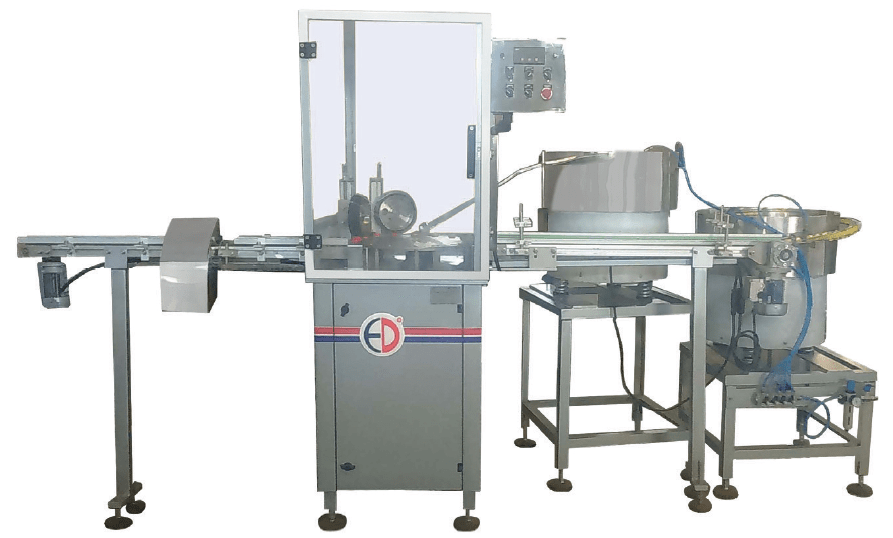
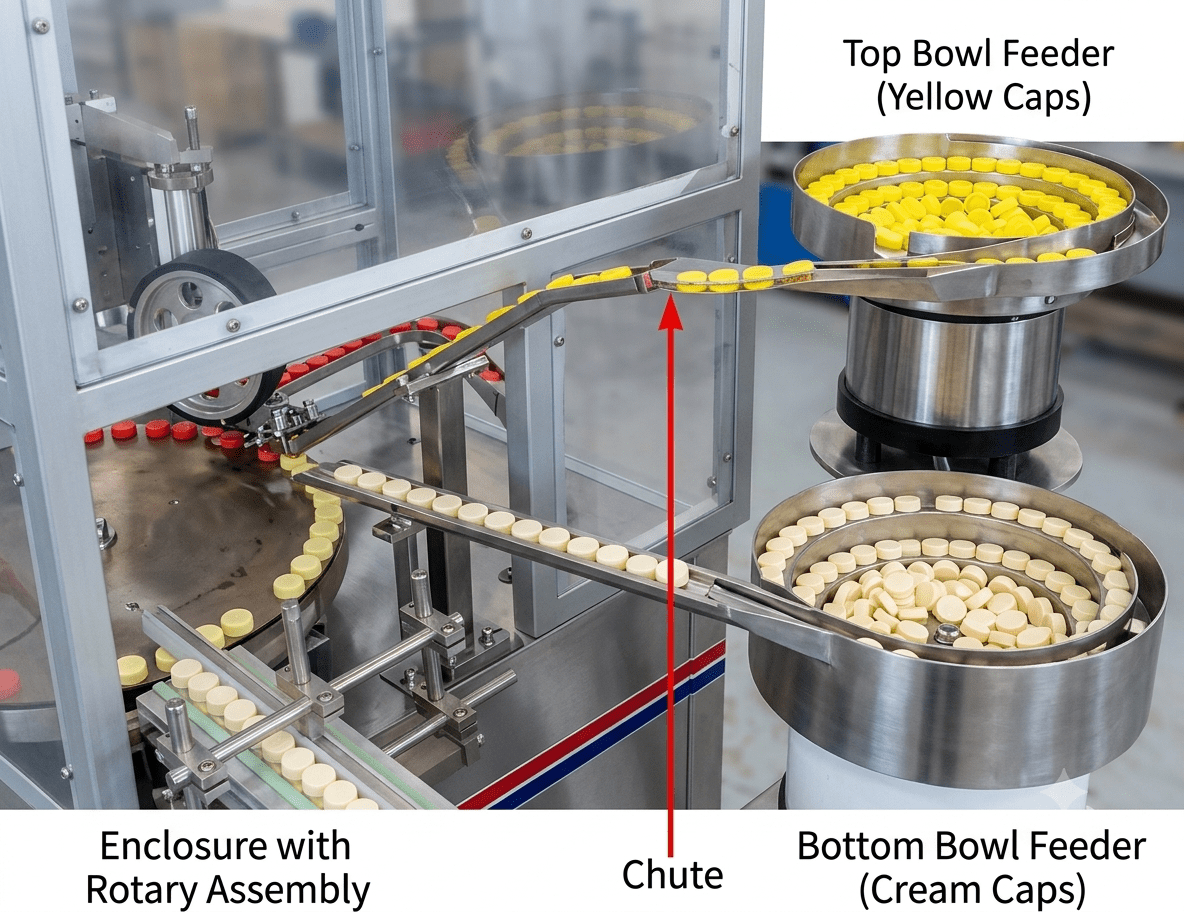
Bottom and top caps are lifted by separate cap elevators into two independent centrifugal rotary bowl feeders. The bottom cap rides a single star wheel; the top cap comes down a gravity chute on a spring-loaded finger and is caught by the passing base cap. An alignment roller and a rotation-and-tightening station then join the two, before assembled caps are inspected, rejected if incomplete, and counted.
Dual
Rotary Bowl Feeders
1
Star Wheel
Align & Tighten
Assembly
100-120 CPM
Output Speed
2-Piece
Cap Assembly Machine
Dual
Centrifugal Rotary Bowl Feeders
1 Star Wheel
+ Gravity Chute
Align & Tighten
Assembly Mechanism
40mm Max, 100-120 CPM
Cap Size & Speed
Sigma CapSeal
Manufacturing Since 1974
A Machine Built to Replace Hand-Fitting a Two-Piece Cap
Some caps aren’t one piece. A bottom component and a top component have to be fitted together before the cap is ready to go on a bottle. Done by hand, that’s a slow station on the line and an easy place for a misaligned cap to slip through. The CTC 100 does that fitting step automatically: two cap elevators lift bulk-dumped caps into two independent centrifugal rotary bowl feeders, a single star wheel carries the bottom cap while the top cap rides a gravity chute on a spring-loaded finger, and an alignment roller followed by a rotation-and-tightening station joins the two.
Two-piece cap assembly has been part of Sigma CapSeal’s machine range since 2003, when the company first introduced 2-piece cap assembly and inserting machines. The CTC 100 sits within that same category.
How the CTC 100 Assembles a Cap
Bottom and top caps travel two separate paths onto the machine before they ever meet, then get checked and counted on the way out. Here’s the full sequence, in the order it happens on the frame.
1
Cap Dumping & Elevation
Bottom and top caps are dumped in bulk. A separate cap elevator for each lifts them up into their own centrifugal rotary bowl feeder to start the cycle.
2
Bottom Cap Feed & Orientation
The bottom cap elevator feeds into a centrifugal rotary bowl feeder, which orients the cap so the wider-diameter side faces down, then delivers it through an entry chute to the star wheel.
3
Top Cap Feed & Positioning
The top cap elevator feeds into its own centrifugal rotary bowl feeder, which orients the cap cavity-facing-down, then delivers it down a gravity chute where a spring-loaded finger holds it in place.
4
Catch & Alignment
The star wheel carries the bottom cap past the spring-loaded finger, which releases the top cap onto it. The caught pair then passes through a silicon alignment roller.
5
Rotation & Tightening
In the rotation zone, a stationary silicon guide ring contacts the top cap, still free to spin since the base cap is locked in the star wheel pocket. That contact rotates and tightens the top cap onto the base cap.
6
Ejection, Inspection & Counting
Assembled caps eject onto the exit conveyor. A sensor checks whether both parts assembled correctly; unassembled caps go to a rejection bin, and good caps are counted for production records.
Watch the CTC 100 in Action
Both bowl feeders, the star wheel, the gravity chute and the rotation-and-tightening station in one continuous cycle.
Want the Full Spec Sheet?
Download the brochure, or send us your cap drawing and we'll confirm tooling and footprint for your line.
What You're Actually Buying
What matters when two separate cap pieces have to become one, cap after cap.
Two Independent Centrifugal Rotary Bowl Feeders
Bottom and top caps are lifted by separate cap elevators and fed and oriented on completely separate centrifugal rotary bowl feeders, so each half arrives correctly oriented before assembly starts.
Single Star Wheel with Gravity Chute Top Cap Feed
One star wheel carries the bottom cap in continuous circular motion. The top cap doesn’t need a second star wheel: it comes down a gravity chute on a spring-loaded finger and is caught by the base cap as it passes.
Alignment Roller & Rotation-Tightening Assembly
Database backup location and backup frequency, password expiry, wrong-attempt limit, date and time formats, screen timeout, password complexity, password change at first login, database limit notification, archival, previous password limit and expiry notification. All preset based on discussion with the customer.
Assembly Verification & Rejection
Every assembled cap is checked by a sensor on the exit conveyor. Unassembled caps are automatically sent to a rejection bin, and good caps are counted for production records.
What This Machine Is Built to Assemble
The mechanism is built around a specific cap structure. Exact tooling details are confirmed against your drawing.
Cap Structure
- A bottom cap component, oriented wider-diameter-side down, carried by the star wheel
- A separate top cap component, oriented cavity-facing-down, fed via gravity chute and spring-loaded finger
- The two pieces are caught together, aligned by a silicon roller, then rotated and tightened by a stationary guide ring
Standard Configuration
- Cap diameter: up to 40 mm
- Output speed: 100 to 120 caps per minute (CPM)
- Bowl feeder, star wheel and gravity chute tooling sized to your cap drawing; footprint, power and construction confirmed at quoting
Getting a CTC 100 Onto Your Line
Every CTC 100 is tooled to the cap it’s assembling. Send us your bottom and top cap drawings, and our applications team confirms bowl feeder, star wheel and gravity chute tooling, footprint and power before it ships.Every CTC 100 is tooled to the cap it’s assembling. Send us your bottom and top cap drawings, and our applications team confirms bowl feeder, star wheel and gravity chute tooling, footprint and power before it ships.
- Bottom cap bowl feeder and star wheel tooling sized to your cap drawing
- Top cap bowl feeder, gravity chute and spring-finger tooling sized to your cap drawing
- Alignment roller and rotation-tightening guide ring set for your cap's assembly tolerance
- Standard configuration runs up to 40 mm cap diameter at 100-120 CPM; footprint, power and construction confirmed at quoting
What We Confirm Before It Ships
Send your bottom and top cap drawings and our applications team confirms tooling and footprint against your exact caps, not a generic range.
Tooling
Sized Per Your Cap
100-120 CPM
Standard Output Speed
Footprint
Confirmed at Quoting
Power
Confirmed at Quoting
Industries Sigma CapSeal Serves
Sigma CapSeal’s cap and closure automation, including cap assembly machines, runs across these sectors.
Pharmaceutical
Consistent cap assembly ahead of induction sealing, where a misassembled cap becomes a failed seal.
Food & Beverage
Cap assembly matched to bottling line speed, without adding a hand-fitting station.
Personal Care
Consistent, correctly oriented cap assembly at retail-line speed.
Agrochemicals
Cap assembly for closures that need to hold up through rough handling in transit.
CTC 100 Technical Specifications
- Parameter
- CTC 100 Specification
Machine Type
Two-piece cap assembly machine, bottom cap and top cap
Cap Loading
Bottom and top caps bulk dumped and lifted by separate cap elevators into two independent centrifugal rotary bowl feeders
Bottom Cap Feed
Centrifugal rotary bowl feeder, oriented wider-diameter-side down, delivered via entry chute to the star wheel
Top Cap Feed
| Centrifugal rotary bowl feeder, oriented cavity-facing-down, delivered down a gravity chute and held by a spring-loaded finger |
Positioning
Single star wheel carries the bottom cap; the top cap is caught from the gravity chute as the base cap passes
Assembly Mechanism
Silicon alignment roller, followed by a rotation zone where a stationary silicon guide ring rotates and tightens the free-spinning top cap onto the locked base cap
Inspection & Output
Assembled caps ejected onto exit conveyor; sensor checks assembly, rejects unassembled caps to a rejection bin, counts good caps
Cap Diameter
Up to 40 mm
Output Speed
100 to 120 caps per minute (CPM)
Construction & Power Input
Confirmed at quoting
Manufacturer
Sigma CapSeal (Electronics Devices Worldwide Pvt. Ltd.)
Cap diameter and output speed above are the standard figures for this model. Construction and power input vary by installation and are confirmed with our applications team before quoting.
50+
Years of Experience
85+
Countries Served
250+
Engineers on the Team
35
Global Service Centers
One-Stop Solution: Assembly to Sealing
Pair the CTC 100 with Sigma CapSeal’s wad/liner inserting, induction sealing and vision inspection equipment, so cap assembly, sealing and inspection all come from one applications team and one service network.
Why Choose Sigma CapSeal for Cap Assembly
Sigma CapSeal has built cap and closure automation since 1974 and shipped India and Asia’s first induction sealer in 1989. Two-piece cap assembly has been part of the range since 2003. It’s equipment backed by a DSIR-certified R and D lab, over 30,000 satisfied customers, and a 98.94 percent on-time delivery record.
Trusted by leading manufacturers worldwide
Nestle
Sun Pharma
Dr. Reddy’s
Tata Tea
ITC
Syngenta
Alpla
Frequently Asked Questions: CTC 100
What packaging engineers, plant managers and procurement teams ask before they buy.
How does the CTC 100 assemble a two-piece cap?
Bottom and top caps are dumped in bulk and lifted by separate cap elevators into two independent centrifugal rotary bowl feeders. The bottom cap is oriented wider-diameter-down and delivered to the star wheel; the top cap is oriented cavity-down and delivered down a gravity chute, held by a spring-loaded finger. As the base cap passes beneath on the star wheel, it catches the top cap. The pair then passes through a silicon alignment roller and into a rotation zone, where a stationary silicon guide ring rotates and tightens the free-spinning top cap onto the locked base cap.
How are the bottom and top caps oriented before assembly?
Each is lifted by its own cap elevator into its own centrifugal rotary bowl feeder. The bottom cap is oriented wider-diameter-side down and delivered via entry chute to the star wheel. The top cap is oriented cavity-facing-down and delivered down a gravity chute, where a spring-loaded finger holds it until the passing base cap catches it.
How are the two caps joined together?
Not by a straight press. After the top cap is caught by the base cap, both parts pass through a silicon alignment roller. The pair then enters a rotation zone, where a stationary silicon guide ring touches the top cap, which is still free to spin since the base cap is locked in the star wheel pocket. That contact rotates and tightens the top cap onto the base cap.
What cap size and speed does the CTC 100 handle?
Up to 40 mm cap diameter, at 100 to 120 caps per minute (CPM), for this model’s standard configuration.
Who manufactures the CTC 100?
Sigma CapSeal, which has built cap and closure automation since 1974, with a DSIR-certified R and D lab and manufacturing facilities in Mumbai, Vasai and Umbergaon, India, and the USA.
What is a two-piece cap assembly machine?
A machine that joins two separate cap components, a bottom piece and a top piece, into one finished closure automatically, instead of an operator fitting them together by hand.
How many star wheels does the CTC 100 use?
One. The star wheel carries the bottom (base) cap in continuous circular motion. The top cap doesn’t sit in a second star wheel; it comes down a gravity chute and is held by a spring-loaded finger until the base cap catches it as it passes by.
What happens to caps that don't assemble correctly?
Assembled caps eject onto an exit conveyor, where a sensor checks whether both parts assembled correctly. Unassembled caps are automatically sent to a rejection bin, and good caps are counted for production records.
Can the CTC 100 run standalone, or does it need to connect to other equipment?
Talk to our applications team about your layout. Sigma CapSeal also builds wad/liner inserting, induction sealing and vision inspection equipment, so a CTC 100 can be planned alongside those machines if your line needs them.
Spec a CTC 100 for Your Line
Send us your bottom and top cap drawings. An applications engineer will confirm tooling, footprint, power and the fit with your existing capping and sealing equipment before you commit.